
1980s-Onset Neoliberal Capitalism Hasn’t Worked for Everyone
New UK Prime Minister, Andy Burnham on the Economy

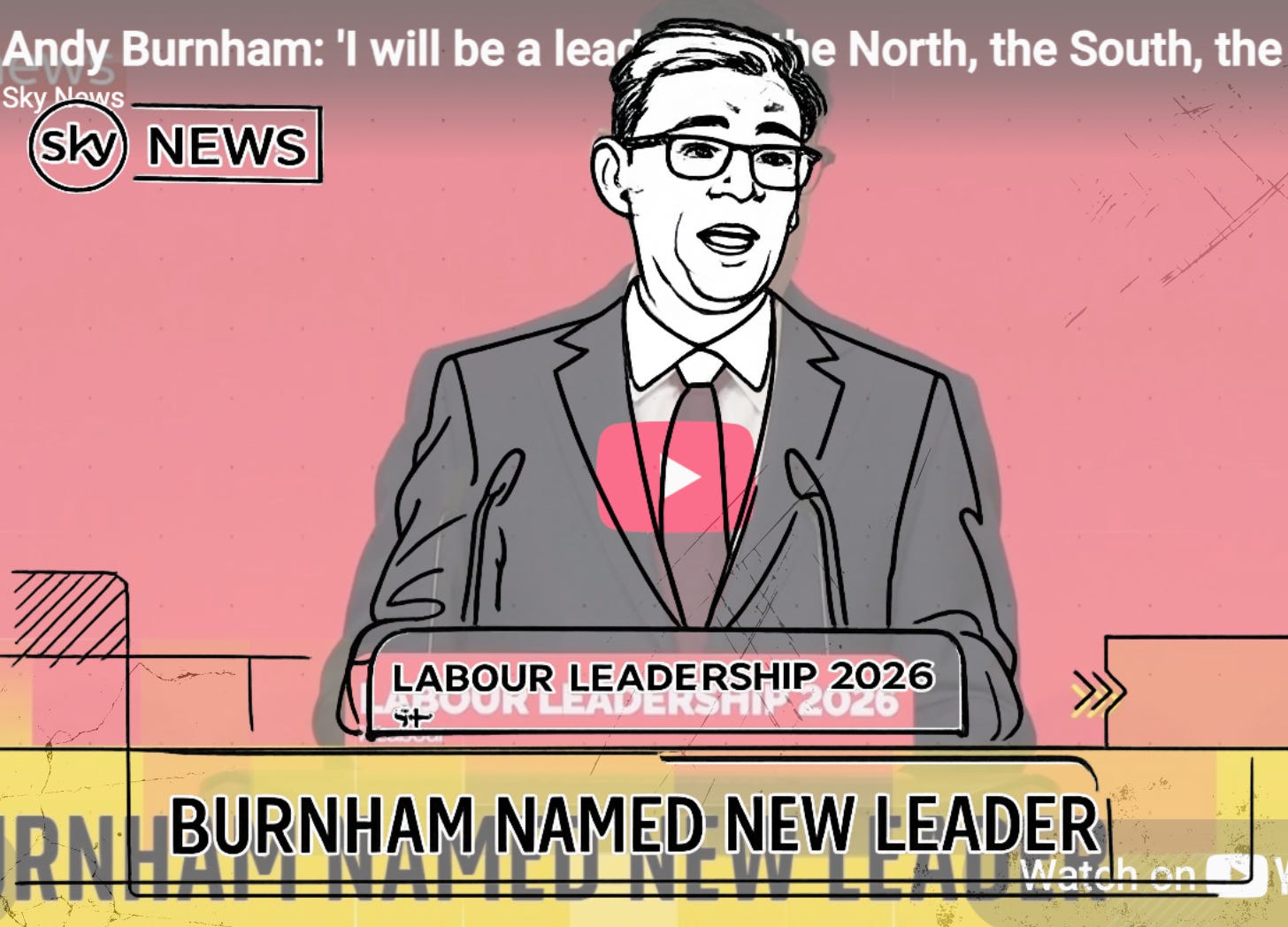
Andy Burnham is the new UK Prime Minister, and today he gave a speech. I found myself agreeing with much of Andy Burnham’s thoughts, but with one persistent question following me all the way through it. If the diagnosis is this clear, is the prescription bold enough?
For years, British politics has often felt strangely reluctant to question the economic settlement that emerged from the 1980s. Governments have argued over how to manage it, how quickly to reform it, or who should benefit from it, but rarely whether the underlying model itself has delivered what it promised.
Burnham is unusual in that respect. He explicitly argues that the neoliberal model that took hold in the 1980s failed many of the communities that built modern Britain, pointing to deindustrialisation, privatisation, over-centralisation and decades of declining living standards in many parts of the country. He argues for a new path built around public transport, affordable housing, stronger public services, devolution and local economic renewal.
For me, that is the most significant part of the speech because of what it signals.
It feels like an acknowledgement that perhaps Britain’s economic difficulties are not simply the result of isolated policy mistakes or recent crises. They may be the cumulative consequence of an economic direction that has been shaping the country for more than forty years.
That feels like an important conversation to have, and it also feels overdue.
Are The Working Class Being Brought Back Into The Conversation?
One aspect I particularly appreciated was the language Burnham chose to use. He spoke repeatedly about working-class communities, deindustrialisation, trade unions, forgotten places and rebuilding the towns that helped create the Labour movement. In recent years, class has often felt strangely absent from political discussion, replaced by a vocabulary that is frequently more managerial than social. Hearing those communities placed back into the story matters.
His emphasis on devolving power also caught my attention. Britain remains one of the most centralised countries in Europe, and Burnham argues that economic renewal cannot simply be designed from Westminster. Instead, he wants greater local control over transport, housing, planning and economic development, drawing heavily on his experience as Mayor of Greater Manchester. Again, I found myself largely persuaded by the diagnosis.
But this is where my questions begin.
Does This Mean Wealth Taxes Are On The Agenda For the UK?
Throughout the speech, Burnham talks about rebuilding Britain, creating affordable essentials, raising living standards and giving people hope. Those are compelling aspirations. What I found myself wanting, though, was a clearer explanation of the mechanisms.
How is this transformation funded? What happens to wealth concentration? How should Britain think about taxation, asset ownership and financialisation?
These questions sit quietly beneath the speech, but they are never really brought into the foreground. Perhaps that is deliberate. Political leaders often begin by building a broad coalition before introducing more detailed programmes.
Or perhaps it reflects a genuine caution about how far Labour should move economically.
Either way, I came away wanting more.
If Neoliberalism Failed, What of Business?
There is another interesting tension running through the speech. Burnham repeatedly describes himself as pro-business while also arguing that the current economic model has failed many ordinary people. Those positions are not necessarily incompatible. Much depends on what we mean by “business.”
Small manufacturers in former industrial towns.
Employee-owned companies.
Local independent businesses.
Multinational corporations.
Private equity.
Utility providers.
They are all businesses, but they often have very different relationships with local communities, workers and wealth creation.
The speech leaves that distinction largely unexplored. None of this should overshadow what I think is genuinely significant.
Burnham appears willing to say something that many mainstream politicians have been reluctant to articulate directly: that the economic settlement established during the 1980s has not delivered prosperity evenly across Britain. He argues that the country needs a different balance between markets, public institutions and local democracy.
Whether his programme ultimately goes far enough is another question entirely. For me, this is where the conversation becomes most interesting. Identifying a problem is not the same as solving it. But identifying it clearly is often where meaningful political change begins.
I finished the speech cautiously optimistic. Not because I think it answers every question, but because it appears willing to ask one that has sat quietly beneath British politics for decades:
What if the economic model itself deserves as much scrutiny as the policies built upon it?
How this Affects Neurodivergent People and Disabled People
One area I found myself thinking about throughout the speech was what these changes might mean for disabled and neurodivergent people.
On the surface, there is plenty to welcome. Better public transport, more social housing, stronger local services and greater investment outside London would almost certainly remove barriers that many disabled people encounter every day. If local areas genuinely had more power to design services around the communities they know best, that could create more flexible employment, shorter commutes, and support that reflects people’s lives rather than fitting everyone into a national template.
For many neurodivergent people, predictability is not a luxury. It is often the difference between participating and burning out. Reliable transport, affordable housing, stable employment rights and accessible public services reduce the amount of cognitive energy spent simply navigating everyday life.
But I also found myself wondering what was missing.
Burnham speaks about rebuilding opportunity, yet says relatively little about the systems that determine whether disabled people can actually benefit from it. If workplaces remain built around constant availability, noisy open-plan offices, rigid schedules and performance measures that reward presenteeism over outcomes, then rebuilding the economy alone may not rebuild access to it.
The same is true of the benefits system. Economic growth does not automatically remove the psychological burden of repeatedly proving your disability, your limitations or your right to support. A more prosperous Britain could still ask disabled people to navigate bureaucracies that consume enormous amounts of time and emotional energy.
Perhaps this points to a wider question.
If neoliberalism asked us to become endlessly productive individuals, what replaces it?
A different economic model matters. But disabled and neurodivergent people also need a different understanding of human value: one that recognises contribution is not always measured in hours worked, uninterrupted productivity or conventional career trajectories.
That, for me, feels like the next conversation.
LJ x