
Neurodivergence, Burnout and Universal Basic Income in Modern Britain
What If Survival Was Less Frightening?

Originally published by LJ Pearce-Coca at ljpearcecoca.com. 9th May 2026
There is a particular kind of exhaustion that does not look dramatic from the outside.
It is the exhaustion of opening another brown envelope. The exhaustion of logging into another portal. The exhaustion of explaining, again, that you are still disabled, still anxious, still autistic, still ADHD, still ill, still not magically transformed into a perfectly productive citizen because a form asked you to account for yourself in boxes. It is the exhaustion of being poor enough to need help, but not trusted enough to receive it without suspicion.
The Finnish UBI Experiment and the Question Beneath It
This is where David Beck’s discussion of the Finnish Universal Basic Income experiment becomes interesting. Not because the Finnish trial gave us a perfect answer. It didn’t. The experiment gave 2,000 unemployed people €560 per month, unconditionally, between 2017 and 2018. It did not dramatically increase employment, which is often the headline critics reach for first. But it did appear to improve things that are harder to reduce to a political slogan: stress, confidence, mental health, trust, stability, and the ability to plan.
And maybe that is the point. Maybe the deeper question was never only:
“Does UBI make people work more?”
Maybe the question was:
“What happens to human beings when survival becomes less frightening?”
Because in the UK, from 1997 to 2026, we have run a very different experiment.
Mental Health Decline in Britain From 1997 to 2026
We have tested what happens when work becomes less secure, benefits become more conditional, housing becomes more expensive, poverty deepens, and more people are asked to hold themselves together inside systems built around proof, pressure, and performance. And the answer, increasingly, seems to be: people get sick.
The Adult Psychiatric Morbidity Survey series shows that common mental health conditions in adults aged 16 to 64 rose from 17.6% in 2007 and 18.9% in 2014 to 22.6% in 2023/24. Among 16 to 24-year-olds, prevalence rose from 17.5% in 2007 to 25.8% in 2023/24. (NHS England Digital)
The longer comparison is just as uncomfortable. The King’s Fund notes that between 1993 and 2014, common mental disorders increased from 15.5% to 18.9%, driven particularly by increases in anxiety and depression. (The King’s Fund)
So the story is not simply “people are weaker now.” That is the lazy interpretation. The more serious interpretation is that the conditions have changed.
Why Work No Longer Feels Like Safety
Work has not disappeared. In many ways, it has expanded. But work has stopped functioning as a reliable route to security for millions of people. Joseph Rowntree Foundation data shows the number of workers living in poverty increased from 2.5 million in 2000/01 to 3.8 million in 2023/24. (Joseph Rowntree Foundation)
That figure matters because it breaks one of the central myths of the modern British welfare imagination: that paid work equals safety.
For many people, it doesn’t.
You can work and still be poor.
You can work and still be one rent rise away from panic.
You can work and still be too exhausted to cook, too overwhelmed to apply for better jobs, too ashamed to admit how close to the edge you are.
And for disabled people, chronically ill people, neurodivergent people, and people with mental health conditions, the situation becomes even more complicated.
Disability Benefits and the Psychology of Conditional Welfare
The conditional welfare system does not simply ask: “What support do you need?”
It often asks:
“Can you prove you deserve support?”
“Can you prove it in the correct format?”
“Can you prove it repeatedly?”
“Can you prove it while unwell?”
“Can you prove it without sounding too capable or too incapable?”
That is not neutral administration. That is a psychological environment.
Why Financial Security Affects the Nervous System
Beck’s discussion of the Finnish experiment matters here because the Finnish trial removed some of that conditional pressure. Participants did not have to constantly prove they were looking for work, and the payment was not withdrawn if they took small amounts of work. The point was partly to test whether a simpler and less stressful form of social security might support people better than a bureaucratic, conditional one.
This is where the idea of “echo-effects” becomes powerful. If someone has a secure income floor, the effect may not stop at their bank account. It may echo outward into sleep, food, cognition, relationships, confidence, and the ability to make decisions. That sounds almost too simple. But anyone who has lived with financial anxiety knows it is not simple at all.
Money is not just money when you do not have enough of it.
Money becomes nervous system regulation.
Money becomes executive function.
Money becomes the ability to answer an email without your chest tightening.
Money becomes the difference between thinking about your future and surviving your afternoon.
Neurodivergent Burnout and the “Canaries in the Coal Mine”
This is where psychologist Lindsay Mackereth’s “canaries in the coal mine” idea becomes especially useful. Mackereth argues that neurodivergent employees are not fragile; they are often early indicators of dysfunction. The workplace may be built around back to back meetings, rigid schedules, sensory overload, unclear communication, and constant availability, and neurodivergent people may feel the damage first, not because they are weaker, but because their systems register the dysfunction earlier. (lindseymackereth.substack.com)
That metaphor changes something.
Because if neurodivergent people are the canaries, then their distress is not just an individual support issue. It is information.
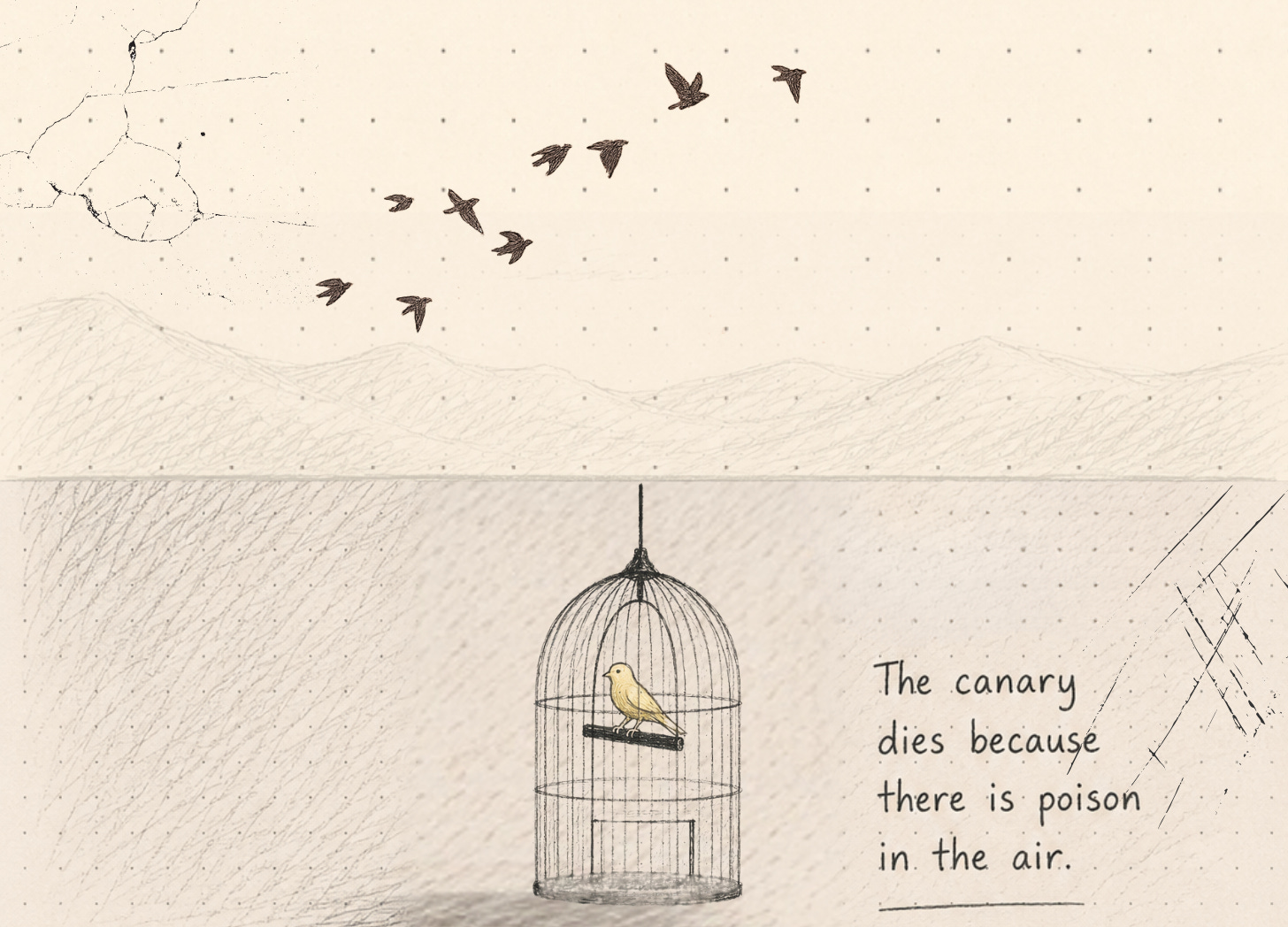
The canary does not die because it lacks resilience.
The canary dies because there is poison in the air.
And this is where many workplaces, welfare systems, and political debates still get it backwards. They look at the person who collapses first and ask: “What is wrong with you?” When the better question might be: “What are you detecting before everyone else?”
The ADHD employee who cannot tolerate chaotic systems.
The autistic employee who burns out under vague expectations.
The depressed worker who cannot keep performing enthusiasm under insecure conditions.
The disabled person who cannot survive a benefits process built around suspicion.
The low-paid worker who is technically “employed” but functionally trapped.
These people are not outside the story of Britain’s future. They may be the early chapters. Because the pressure is spreading.
What Happens When Systems Extract More Energy Than They Return
The UK’s 2025 sickness absence figures show 148.8 million working days were lost to sickness or injury, 9.8 million more than in 2019. (Office for National Statistics) The government’s 2026 Keep Britain Working review described a “quiet but urgent crisis,” noting that over one in five working-age adults are out of the workforce, substantially because of health problems, while disabled people remain locked out of work at twice the rate of non-disabled people. (GOV.UK)
So perhaps the issue is not that too many people have become dependent. Perhaps the issue is that too many people have been asked to function inside systems that extract more energy than they return. And here is the contradiction I keep coming back to.
The UK is now moving toward stronger employment protections. The Employment Rights Bill/Act reforms include measures around exploitative zero-hours contracts, fire and rehire, day one rights, sick pay, unfair dismissal, bereavement leave, and other protections. (Acas)
That matters. It is not nothing. But it also reveals the scale of what went wrong. If, in 2026, we are trying to repair basic security at work, then the question is not only what new rights are coming. The question is what people have been living without.
Reasonable notice of shifts.
Security against sudden dismissal.
Sick pay that does not punish illness.
Protection from being rehired on worse terms.
A basic sense that your life is not completely disposable.
These are not luxuries. They are the minimum conditions under which a person can begin to plan. And planning matters. Planning is not just a productivity skill. Planning is a mental health resource.
Why Planning Is a Mental Health Resource
People cannot build lives when everything is provisional. They cannot regulate their nervous systems around “maybe.” They cannot heal while being constantly reassessed. They cannot take creative risks, care risks, educational risks, or work risks if one mistake means falling through the floor. This is why UBI remains such a morally irritating idea. Not because it answers everything. It doesn’t. A basic income would not automatically solve housing, ableism, workplace discrimination, NHS waiting lists, poor management, social isolation, or the deep cultural suspicion aimed at people who cannot work full time.But it does challenge one of the most exhausting assumptions in the current system: that people must be pressured into usefulness before they are allowed to feel safe.
What If Security Came Before Productivity?
Beck’s reading of the Finnish trial suggests something more humane and, frankly, more psychologically literate: security may come first. Functioning may come after.
That is the reversal.
Not: prove you are productive, then we may let you survive.
But: survive first, then let us see what becomes possible.
For neurodivergent people, that distinction is enormous.
ADHD is not helped by constant panic.
Autism is not helped by sensory and bureaucratic overload.
Chronic illness is not helped by suspicion.
Depression is not helped by poverty.
Anxiety is not helped by conditional survival.
And yet so much of the British system seems to operate as if pressure is motivational. Sometimes pressure does motivate. But sometimes pressure disables. Sometimes it does not push people into work. It pushes them into shutdown, burnout, relapse, avoidance, or despair. It makes them smaller. Less imaginative. Less able to take the very steps the system claims to want from them. That is the hidden cost. A welfare system built around proving need may save money in one column while creating damage in another: poorer mental health, reduced trust, administrative overwhelm, crisis reliance, family strain, and a population increasingly too exhausted to participate fully in civic or working life.
This is not only about people out of work. It is also about people just about surviving in work.
The person who looks fine because they still reply to emails.
The person who still pays rent but has no margin.
The person who earns too much to be helped and too little to be safe.
The person who keeps going because stopping would be financially impossible.
They are not thriving. They are maintaining the appearance of functioning.
And this is where the canary metaphor becomes less comforting. Because if neurodivergent people are dropping first, that does not mean everyone else is fine. It may mean everyone else has a slightly longer fuse. The same workplaces that overwhelm ADHD and autistic people often drain everyone eventually: unclear expectations, impossible workloads, insecure contracts, surveillance, low autonomy, poor rest, and the constant demand to be cheerful about it. Neurodivergent people may simply reach the point of visible distress sooner. That should make us listen, not dismiss them.
A humane society would treat these early signals as design feedback.
It would ask:
What if benefits were less humiliating?
What if work was less brittle?
What if support was not framed as special treatment?
What if security was considered part of public health?
What if the people struggling first were not the problem, but the warning?
What Happens to Human Beings When Survival Becomes Less Frightening?
The Finnish experiment did not prove that UBI is a magic answer. But it did something more useful. It gave us evidence that reducing financial fear can improve people’s wellbeing, confidence, trust, and stability, even when employment outcomes are mixed.
That should matter more than it currently does. Because employment is not the only measure of a life.
A person who sleeps better matters.
A person who feels less ashamed matters.
A person who can plan next month matters.
A person who is not constantly forced to perform desperation to survive matters.
Maybe the question is not whether we can afford to make survival less frightening. Maybe the question is how long we can afford not to.
To be continued.
If you want deeper analysis and reflections about writing, books, social systems, or the ideas explored here, I share a mixture of free posts and paid deeper dives on Substack. You can find more at ljpearcecoca.com.
References
Beck, D. (2023). Experimenting with unconditional basic income: Lessons from the Finnish BI experiment 2017–2018, by Olli Kangas, Signe Jauhiainen, Miska Simanainen and Minna Ylikännö. 2021. ISBN: 978-1-83910-484-8. Social Policy & Administration, 57(3), 456–457. https://doi.org/10.1111/spol.12839
Department for Business and Trade. (2024, October 10). What does the Employment Rights Bill mean for you? GOV.UK.
Digital NHS. (2025). Adult Psychiatric Morbidity Survey: Survey of Mental Health and Wellbeing, England, 2023/24.
Joseph Rowntree Foundation. (2026). Work and poverty.
Mackereth, L. (2025). Neurodivergent employees aren’t fragile — they’re the canaries in the coal mine. Substack.
Office for National Statistics. (2026). Sickness absence in the UK labour market: 2025.
UK Government. (2026). Keep Britain Working: Final report.