
The Quiet Research Behind Writing a Book
And Why I’m Reading 12 Books This Year

Some quick housekeeping and orientation: I started this substack and originally wrote more overtly about topics of the pressures of modern life, especially for neurodivergents, but also for everyone, how our economic policy choices, or rather the decisions impressed upon us, impact us as humans, and not always for the better. I will still touch on these topics, as I’m immensely curious about UBI, for example, but I am writing fiction, so you will see more of that type of content too, but just know the former ideas do still inform my work. So there you go, hopefully that explains things a little better. I look forward to writing on here more.
When people start thinking about writing a book, one of the most practical questions turns out to be surprisingly simple:
Where would this book actually sit in the world?
Quite literally, where might readers encounter it?
One way to explore this is through something the publishing world calls comp titles. I’ve never particularly liked that phrase because it suggests competition, as if books are somehow trying to defeat each other in a Battle Royale-style showdown. Modern Economic Policy gets into everything I find, and it can be exhausting sometimes when you want to make something.
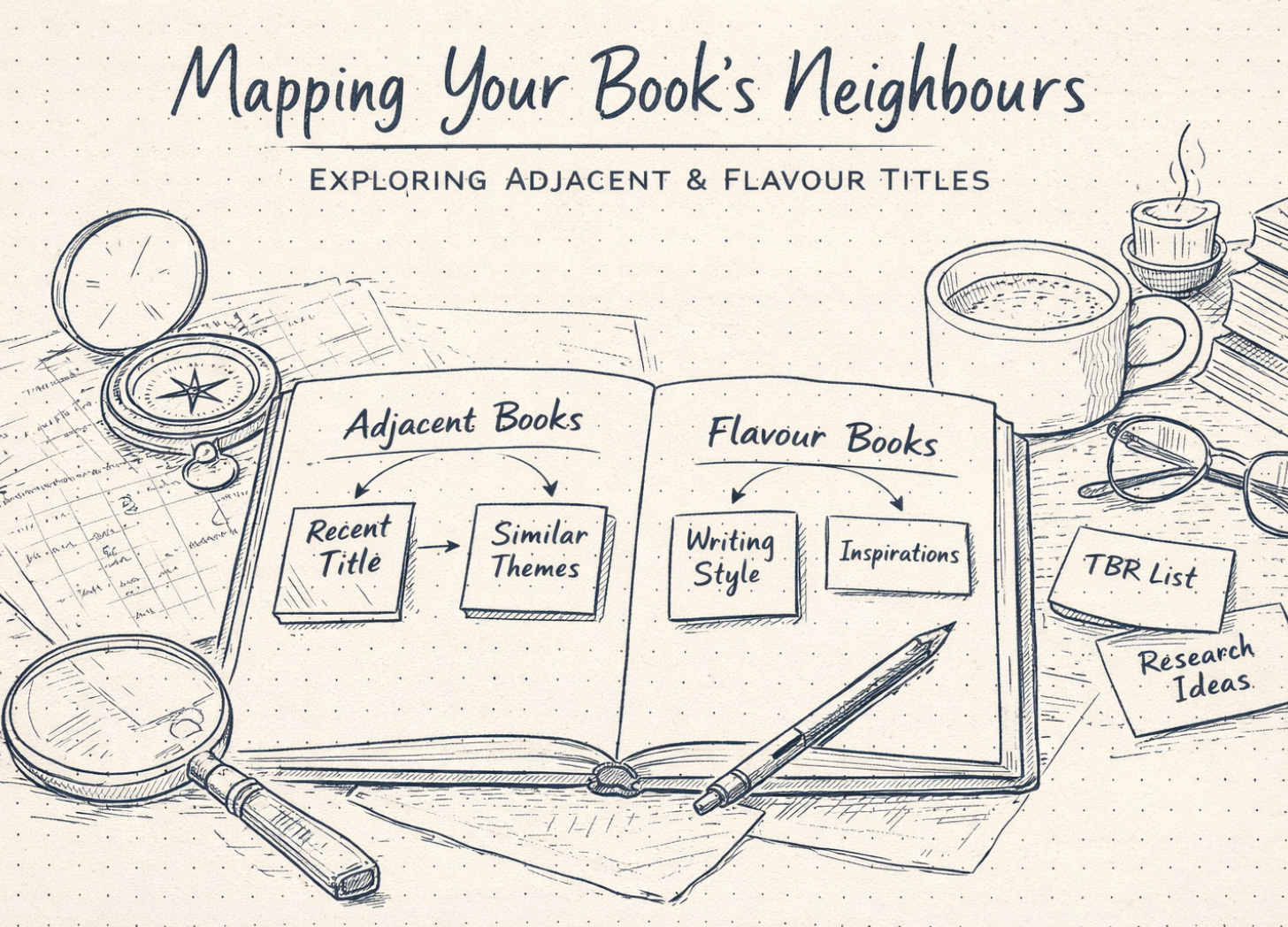
In reality, it’s closer to finding your book’s neighbours, books that live in the same general space as the one you’re trying to write. These other books might share a genre, similar themes, or overlapping subject matter. The goal isn’t imitation, it’s orientation. Understanding the landscape your idea might eventually enter.
Step 1. Books Adjacent To Yours
A simple place to begin is with books published fairly recently, usually within the last one to five years. If you want to be stricter with yourself, you could narrow that to the last three years.
Then pick one book that feels adjacent to the one you’re imagining.
Look it up on Amazon, Goodreads, or your library catalogue. If you scroll down far enough, most platforms quietly reveal something useful: the section “Customers also bought”, showing what other readers bought alongside that book. What you’re seeing there is essentially a small map of that book’s neighbourhood. From there you can preview the first few pages and ask yourself:
Does this feel like the kind of space my book might live in?
If the answer is yes, add it to a list.
Over time, that list becomes something like a reading map for your project.
Step 2. Books With The Same Flavour As Yours
But there’s another category of books that can be just as useful. These aren’t necessarily adjacent books. They’re what I think of as flavour books. These are the books that shape the feel of your writing rather than the exact genre.
For example, you might find a book tackling a similar theme but for a different audience. Or a book that explains something complex in a way that suddenly makes the whole subject clearer. Sometimes the influence is stylistic rather than conceptual. You might admire how an author structures a story. Or how they simplify difficult ideas. Or how they hold attention across chapters.
These books become part of the creative ecosystem that feeds your work. The process for finding them is similar.
Start with one book that captures the flavour you’re drawn to. Look it up, scroll through the recommendations, preview the opening pages, and ask yourself:
Does this book help me think about how I want to write?
If the answer is yes, add it to the list.
Step 3. Reading!
Eventually, you’ll have two reading lists. One list of adjacent books: the neighbourhood your book might live in. And another list of flavour books: the influences shaping how you want your work to feel and the themes you like to explore.
At that point, something interesting becomes possible. You can turn those lists into a reading practice. For example, you might decide to read one book per month for a year, using a mixture from both lists. Twelve books that gradually sharpen your sense of the territory your book belongs to.
And it’s worth saying something important here. You don’t have to finish every book you start to read. If a book stops being interesting, that’s information. You’ve learned something about what draws you in, and what doesn’t. You can simply move on, to another one on the list.
I should say that this is something I’m experimenting with at the moment.
It’s still early days for me. I’m curious to see what patterns emerge after doing this for a while. My plan is to come back and write another piece once I’ve lived with the process a little longer and can see what it actually changes in my own writing.
So for now, think of this less as advice and more as a small working experiment.
Where did this idea come from?
The idea itself isn’t originally mine. I first came across this approach through Gabriela Pereira, who runs DIYMFA. Her book and podcast explore the idea that you can build something very close to a creative writing MFA (or in the UK, a creative master’s degree) without necessarily enrolling in an institution. Instead of paying for a formal programme, you build your own learning ecosystem through reading, writing, and engaging with creative work.
For some people, the community aspect of a formal programme is the real value. For others, the structure. For me personally, the autonomy matters more. As someone who is autistic and ADHD, the ability to study asynchronously and in environments that work for my sensory system makes a huge difference to the quality of my thinking.
Home works well.
Libraries work well.
Quiet hotel bars sometimes work surprisingly well.
Places where I can concentrate without constantly adjusting myself to the environment.
To be honest, I’ve rarely had a particularly good experience in traditional work or education spaces. The marketing around support for neurodivergent people often sounds much stronger than the reality I’ve encountered. I’m sure that isn’t true everywhere. And things have improved so much, with awareness rising year by year. But it’s not perfect, and there’s still work to be done there.
In the environments I’ve personally experienced, I’ve often found that I simply work better alone. Or I work better with body doubling, where I engage in a kind of parallel play in my work, with someone else there doing something separate to me. But library quiet study areas and quiet hotel bars can give me this.
If you’re different to me, DIYMFA does (or at least did) offer options to interact live with the founder and other writers if you enjoy learning in a group. If that kind of real-time community energises you, it might be worth exploring those options, or whether they are still available.
But the core idea doesn’t require any of that. You can quietly build your own creative education in whatever spaces allow you to think most clearly.
Which makes me curious about something. If you write, or if you’re trying to write, where do you actually work best? Inside institutions and structured programmes? Or in quieter, self directed spaces where you can think at your own pace? I suspect the answer varies more than we’re usually led to believe.
to be continued…